Programma della conferenza
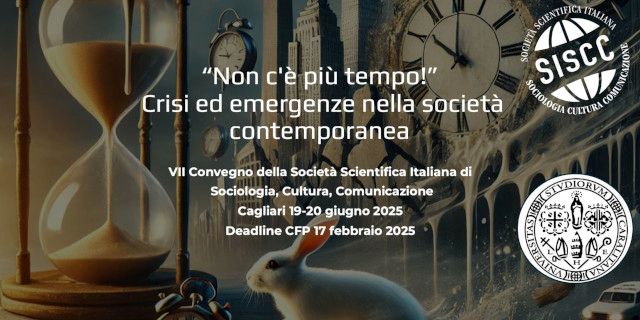
VII “Non c’è più tempo!” Crisi ed emergenze nella società contemporanea / Cagliari, 19/20 giugno 2025
In un’epoca segnata da crisi ricorrenti e da un senso di urgenza perpetua, il concetto di tempo emerge come una lente imprescindibile per analizzare e comprendere la società contemporanea. Il convegno SISCC 2025, organizzato dalla “Società Scientifica Italiana di Sociologia, Cultura e Comunicazione”, intende riflettere sulle molteplici declinazioni del tempo nel contesto delle crisi odierne, esplorando come l’accelerazione dei ritmi di vita e la proliferazione delle emergenze stiano ridefinendo dimensioni fondamentali dell’educazione, della comunicazione e della vita quotidiana.
|
Daily Overview |
| Sessione | |
|
Sessione 4 - Panel 06: Opinione pubblica, manipolazione e conflitto Luogo, sala: Aula 6 (A1-F) Chair di sessione: Augusto Valeriani | |
    | |
Simulating Grassroots Support: The Role of Coordinated Networks in Pro-Putin Information Operations Università di Urbino, Italia The rise of coordinated online behavior in disseminating content to shape political discourse has become a focal point of academic inquiry. Social media platforms facilitate both authentic political engagement and manipulative strategies to influence public opinion. This interplay is evident during elections and geopolitical crises, where information operations exploit social media affordances to spread deceptive content (Giglietto et al., 2020a; 2020b; 2023). While text-based coordination has been extensively studied, contemporary challenges necessitate a closer focus on visual media—particularly short-form videos and AI-generated imagery, which pose detection difficulties. This study employs the Vera AI Alerts system, developed as part of a European research initiative, to detect coordinated link-sharing activities on Facebook. Using CrowdTangle API data (October 2023–August 2024), 7,068 coordinated posts, 10,681 coordinated links, and 2,126 new accounts were identified. Among the detected networks, three notable cases emerged: exploited large groups sharing sexual content, casino engagement bait, and pro-Putin fan groups. This paper focuses on the latter, investigating key themes emerging from the coordinated sharing of posts and images in these groups. Findings highlight 15 public Facebook groups promoting Russian geopolitical interests. This is the most traditional form of strategic information operation to promote political propaganda, resonating with Chadwick and Stanyer’s (2022) framework of deception driven by political motivations. These groups blend neutral and polarizing content to shape narratives, embedding urban development posts alongside ridicule of Western leaders. Their structural similarities—including naming conventions, identical group descriptions, and synchronized name changes—suggest systematic coordination. Notably, some groups altered names in early 2022, preceding Russia’s invasion of Ukraine, indicating strategic adaptation. Thematic content falls into two categories: (1) posts disparaging Western leaders and Ukraine and (2) content bolstering Putin’s image. A widely circulated meme, posted simultaneously across groups on February 12, 2024, mocks Ukrainian President Zelenskyy, coinciding with battlefield developments. AI-generated images portray Putin in heroic poses, reinforcing his appeal. Nationalist symbols—such as a Russian bear wielding a Kalashnikov rifle—further amplify ideological messaging. The deliberate integration of apparently benign material, such as posts celebrating Moscow’s urban development, alongside more explicitly politically polarising content, such as mocking the Ukrainian President, exemplifies the gaslighting nature of these strategic information operations, fostering confusion and advancing a specific agenda (Jack, 2017). Amplification strategies exploit Facebook’s platform affordances to maximize engagement. Coordinated posting ensures identical content appears in multiple groups within short intervals, creating an illusion of organic popularity and increasing algorithmic prioritization. "WorldRusWorld,” a group managed by Bulgarian and Russian administrators, exemplifies this strategy, posting identical pro-Putin content across ten groups within minutes. Multilingual dissemination extends reach, with content appearing in Russian, English, and Arabic, aligning with broader cross-cultural disinformation tactics. Engagement metrics reveal variations in effectiveness. While some posts attracted minimal interaction, others exceeded 1.1 million views, demonstrating the hybrid nature of these campaigns. Initial coordination relies on a small group of actors, but broader amplification depends on organic user participation, blurring the distinction between orchestrated and authentic engagement. This study contributes to research on political information warfare by examining the mechanisms behind visual content coordination. Findings highlight state-aligned actors simulating grassroots support while exploiting social media affordances. These insights underscore the need for further research into AI-generated content and multimodal disinformation detection in the evolving digital landscape. | |