Programma della conferenza
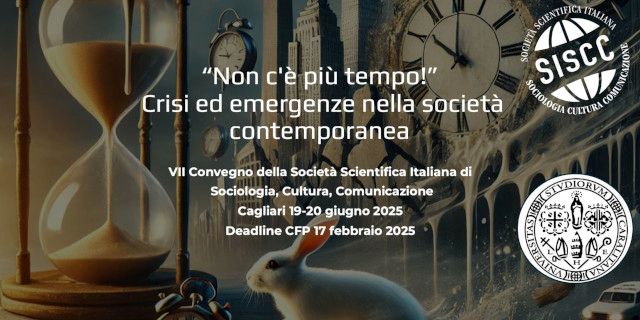
VII “Non c’è più tempo!” Crisi ed emergenze nella società contemporanea / Cagliari, 19/20 giugno 2025
In un’epoca segnata da crisi ricorrenti e da un senso di urgenza perpetua, il concetto di tempo emerge come una lente imprescindibile per analizzare e comprendere la società contemporanea. Il convegno SISCC 2025, organizzato dalla “Società Scientifica Italiana di Sociologia, Cultura e Comunicazione”, intende riflettere sulle molteplici declinazioni del tempo nel contesto delle crisi odierne, esplorando come l’accelerazione dei ritmi di vita e la proliferazione delle emergenze stiano ridefinendo dimensioni fondamentali dell’educazione, della comunicazione e della vita quotidiana.
|
Daily Overview |
| Sessione | |
|
Sessione 2 - Panel 06: Genere, identità e intimità Luogo, sala: Aula 6 (A1-F) Chair di sessione: Paola Rebughini | |
    | |
Negotiating migrant masculinities in the context of domestic time and space 1: University of Trento, Italy; 2: University of Glasgow, Regno Unito; Gran Bretagna How is the temporality of migration gendered, shaping migrants’ social mobility across the public/private divide? This paper explores the gendered nature of social time in relation to men who migrate as ‘followers’ of their wives and work as domestic/care workers in Italy. The analysis focuses on men’s temporal experiences of the home, family, and reproductive labour. It suggests, first, how time dilution through ‘waiting’ before emigration and loss of agency constitute an important feature of men’s experiences of dependency and de-skilling, and, secondly, how men negotiate domestic time and space to reassert autonomous male subjectivities as breadwinners. First, our paper develops a much-needed gendered analysis of the relation between migration and time, mapping how migrant masculinities are forged over biographies and different stages of migration and of the life course, reflecting migrant men’s experience of domestic time. Second, it complements existing analyses of migrant reproductive labour – which mainly focuses on femininities and on space across the private/public divide – through a discussion of the temporal dimensions of men’s (paid and unpaid) care/domestic work. Our method sheds light on the temporality of gendered migration: we conducted extensive ethnographic research including biographical and semi-structured interviews, in some cases with the same informants, over 15 years. This long timeframe revealed how, in individual biographical trajectories, entering or leaving paid care/domestic work informs shifting models of gender identification across time and through time. | |